Ailacra: AI-Powered Template Documentation

Circle what's present. Backslash what's absent. AI writes the note — and scores the coding. Ailacra transforms structured clinical selections into complete narratives, automated ICD-10/CPT codes, and a real-time MDM level in seconds, not minutes.

Built for the Pace of Emergency Medicine

A complete clinical intelligence platform — not a simple template editor

120+
Physician templates
3,000+
Detail subtemplates
658
Diagnoses managed
2,075
Diagnostic rules
574
Complexity rules

What Ailacra Adds

Ailacra replaces typing with structured selection and AI — then goes further with a full clinical intelligence engine:

  • AI narrative generation transforms structured selections into physician-quality prose
  • Circle and backslash captures pertinent positives and negatives in a single tap
  • Expert-system rules automatically assign ICD-10 codes, CPT procedure codes, and E/M level as you document
  • Over 2,000 rules organize and prioritize 658 possible diagnoses in real time
  • Rare and atypical diagnoses are automatically surfaced when clinical findings support them
  • Red flag rules highlight dangerous findings that warrant immediate attention
  • AI diagnosis harvesting suggests additional diagnoses from documented findings for physician review
  • Dynamic templates adjust content for patient sex, age group, and documented findings
  • Multi-provider workflow lets nurses and physicians work the same encounter simultaneously

How Ailacra Works

From chief complaint to coded clinical narrative in five steps

1

Select Chief Complaint

Tap a body region on the anatomical diagram or choose from the template picker. Ailacra loads a chief-complaint and mechanism-specific template tailored to the presentation—MVA, GSW, chest pain, altered mental status, and 120+ more. Nurse templates load automatically for nursing staff.

2

Mark Findings

Circle items that are present. Backslash items that are absent. Each touch is one tap—no dropdowns, no checkboxes, no typing. Pertinent positives and negatives are captured simultaneously. As findings are marked, the diagnostic differential and MDM level update live.

3

Expand with Subtemplates

Tap any finding marked with ▶ to open a subtemplate for granular detail. Over 3,000 subtemplates cover medication lists, pain characteristics, wound descriptions, lab result entry, imaging findings, and more—without leaving the workflow.

4

AI Generates the Narrative, Diagnoses, and Codes

An LLM transforms structured selections into fluid clinical prose. Simultaneously, the expert-system engine assigns ICD-10 codes, CPT procedure codes, and computes the MDM level and E/M code (99281–99285) based on documented data—no separate coding step required.

5

Copy to EMR

One-click clipboard copy or SMART on FHIR integration pushes the narrative directly into your EMR. Works with Epic, Oracle Health, and other systems that support standard integration protocols. Lab values and chart data can be imported from the EMR automatically.

From Selections to Narrative

Circle and backslash findings; AI produces the clinical note

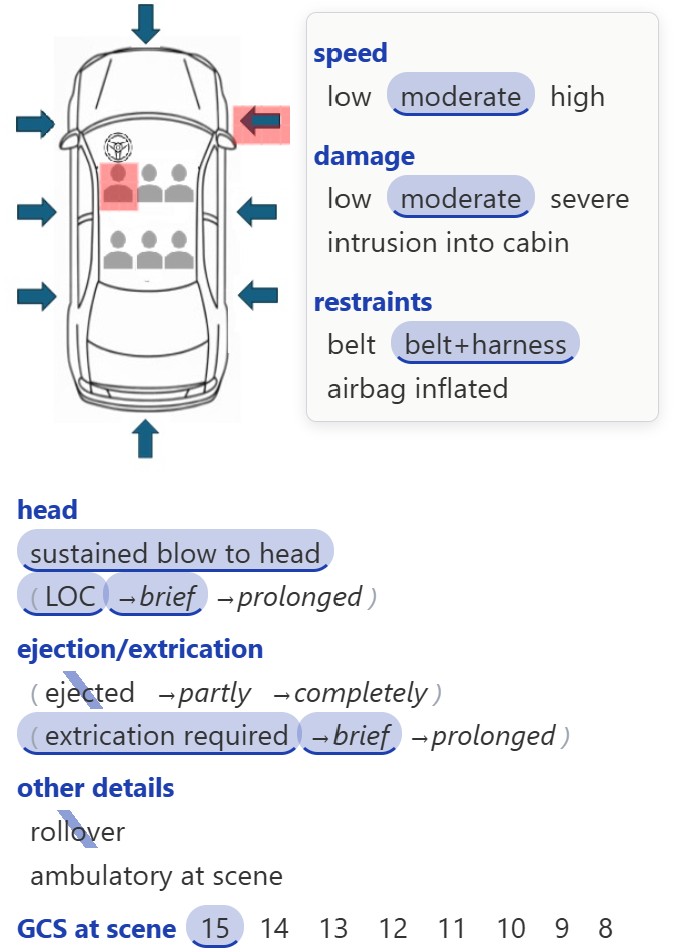
MVA Template — Circle & Backslash
Ailacra MVA template with circled and backslashed findings
AI-Generated Narrative

CHIEF COMPLAINT: MVA
Historian: patient (good historian)

HISTORY OF PRESENT ILLNESS: This 55 YO male presents after a motor vehicle accident that occurred just prior to arrival. He was the driver of a vehicle that was struck from the front right side at a moderate speed, resulting in moderate damage. He was restrained with a belt and harness and experienced a brief loss of consciousness. Although extrication was required, he was ambulatory at the scene and had a GCS of 15. He was not ejected from the vehicle, and there was no intrusion into the cabin or rollover.

Diagram-to-Narrative

Draw on anatomical diagrams; AI converts strokes to clinical text

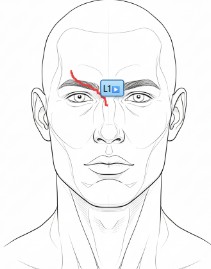
Body Diagram — Laceration Drawing
Laceration drawn on anatomical head diagram
AI-Generated Description

Head: There is an 8 cm superficial, linear, and clean laceration of the head, beginning at the right lateral forehead, coursing through the paramedian forehead, eyebrow area, and paranasal area, then through the nasion, and ending at the nasal bridge.

Multi-Provider Workflow

Nurses and physicians work the same encounter — simultaneously

Nurse Templates

Nursing staff have their own complaint-specific charting templates for triage, vital signs, assessments, and interventions. Role-based access ensures nurses see templates appropriate to their scope of practice.

Shared History Collection

Nurses can collect history using a replica of the physician's complaint-specific history tab. The physician can review the nurse's documented findings and import them directly into their own note with a single tap.

Role-Based Access

Physician, nurse, admin, and editor roles each have distinct permissions. Physicians sign and close encounters; nurses document and attest. Entries are timestamped and attributed to the individual provider.

Clinical Intelligence Engine

Expert-system rules work in the background as you document

Differential Diagnosis Management

2,075 rules continuously organize 658 possible diagnoses into three tiers as findings are marked. Common diagnoses are demoted when findings don't fit; rare diagnoses are promoted when clinical evidence supports them. The differential updates with every tap.

Rare Diagnosis Surfacing

Uncommon and population-specific diagnoses sit in a third tier by default. When documented findings — risk factors, lab results, pain location, or exam findings — match a rare diagnosis's promotion criteria, it moves into the active differential automatically.

Red Flag Alerts

Red flag rules monitor documented findings for dangerous patterns. When a red flag condition is met, a visual alert highlights the finding to ensure it is not overlooked in a busy shift.

Complexity Scoring

574 expert-system rules evaluate presenting findings against AMA 2021 criteria to classify problem complexity. The result feeds directly into MDM Element 1 and the E/M level calculation.

AI Diagnosis Harvesting

Beyond the rule-based differential, AI analyzes documented findings across all tabs and suggests additional diagnoses for physician review. Physician confirms, rules out, or dismisses each suggestion.

AlertDX Integration

As findings are marked, Ailacra streams data to AlertDX. AI-generated clinical alerts arrive in real time, providing an independent safety net against missed diagnoses running alongside documentation.

Automated Coding — No Separate Step

ICD-10 codes, CPT procedure codes, and E/M level assigned as you document

ICD-10 Coding

Diagnoses confirmed on the DDx tab are automatically matched to ICD-10-CM codes. The system uses an expert-system engine with AI assistance, with a review queue for edge cases.

CPT Procedure Codes

Procedure codes are assigned automatically when procedures are documented on the template. Rules account for complexity factors like laceration length, burn depth, and procedure type.

Real-Time MDM Scoring

All three AMA 2021 MDM elements are computed live: problems addressed, data reviewed, and risk of complications. The E/M level (99281–99285) updates as documentation progresses.

Data Reviewed Tracking

Labs ordered, imaging reviewed, consultations obtained, and outside records are automatically tallied toward MDM Element 2 as studies are documented. Independent interpretation and external discussion are tracked separately.

Key Features

Clinical documentation designed for the pace of emergency medicine

AI Narrative Generation

LLM-powered prose from structured selections. Produces physician-quality clinical notes from circled and backslashed findings across history, exam, and studies tabs.

Circle & Backslash

The proven charting method, enhanced with AI. Intuitive single-tap marking adapted in one shift. Circle for present, backslash for absent.

Diagram-to-Narrative

Draw findings on anatomical body diagrams. Strokes and labels convert automatically to structured clinical text. Supports lacerations, burns, GSW, shrapnel, ecchymosis, and more.

Nurse Charting

Dedicated nurse templates for triage and assessment. Nurses can also collect history using the physician's complaint-specific tab; physicians review and import with one tap.

120+ Templates

Medical and trauma presentations across adult, pediatric, and infant age groups. Chief complaints from chest pain to psychiatric emergencies to multi-system trauma.

Medical & Trauma Templates

Adult and pediatric medical templates for presentations like chest pain, abdominal pain, and altered mental status. Trauma templates tailored by mechanism—MVA, GSW, stab wound, fall, blast, and more.

Dynamic Templates

Template content adjusts dynamically based on patient sex, age group, and documented findings. Items that don't apply to the patient are automatically hidden.

Lab Auto-Population

Lab result values are imported from the EMR and automatically fill numeric fields and result arrows on the studies tab. Repeat values (e.g., troponin) are handled separately.

EMR Integration

SMART on FHIR integration for Epic, Oracle Health, and other systems. Auto-imports medications, allergies, problems, and surgical history. Clipboard copy available as an alternative workflow.

Freestanding Mode

Operates without an external EMR. Includes patient registration, encounter management, and direct chart data entry with medication autocomplete via RxNorm.

Customizable Templates

JSON-based templates editable in place. Sites and individual practitioners can modify or extend templates with no rebuild or redeployment needed.

Session Persistence

All template marks are saved per-encounter and restored automatically. Supports multi-tab, multi-provider workflows.

Security & Compliance

Built for HIPAA from the ground up

🔐

Multi-Factor Authentication

TOTP-based MFA with site-level enforcement. Trusted device support for 30 days.

📋

Full Audit Trail

All data access and clinical actions are logged with who, what, and when. Break-glass emergency access is tracked and queued for review.

🏥

Multi-Tenant Isolation

Each site's data is fully isolated. No cross-tenant data access is possible at the database or API layer.

🔒

Encryption

Data encrypted at rest (KMS) and in transit (TLS). Credentials managed via Secrets Manager — no hardcoded secrets.

Bring Ailacra to Your ED

Ready to transform clinical documentation at your institution?

Contact us to learn about deployment options, EMR integration, and how Ailacra can reduce documentation burden for your physicians and nurses.

info@aistellor.com