Structured Alerts
Alerts bring conditions to the clinician's attention
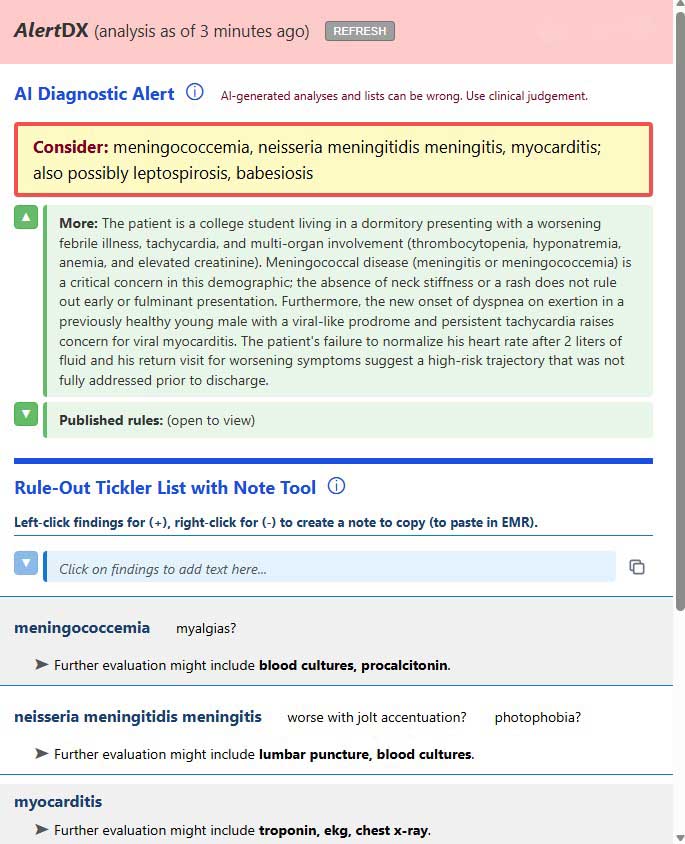
AI-powered secondary review that catches diagnostic errors before they cause harm. AlertDx provides an extra layer of safety for clinical decisions.
Source: AHRQ Systematic Review, 2022.
Cognitive errors do not equate to lack of knowledge or care but reflect how human thinking works under the hectic pace of emergency departments:
The National Academy of Medicine has called diagnostic error a “blind spot” for modern medicine and improving diagnosis a “moral, professional, and public health imperative.”
Continuous surveillance with on-demand AI-assisted documentation
AlertDx maintains a background data engine that periodically accrues new clinical data—labs, vitals, imaging, clinical notes—via FHIR delta queries. The system constantly updates its differential diagnosis for each patient.
When a clinician opens a patient record, AlertDx provides an immediate safety check via a CDS Hook. If the analysis indicates a possible missed dangerous diagnosis, a high-priority Red alert card appears with a link to the full analysis. Blue and Orange analyses remain silent to prevent alert fatigue, but are available upon demand.
Clinicians can launch AlertDx at any time via a button in the EMR. The SMART on FHIR tool provides AI-assisted differential diagnosis, a medical decision-making documentation tool, and a findings addendum builder. Frontier generative AI analyzes the full clinical context—not just rules or thresholds.
After the encounter note is finalized, AlertDx runs a final analysis. If a Red event is detected post-finalization, an alert is delivered to the clinician’s inbox, closing the loop even after the clinician has left the chart.
Alerts bring conditions to the clinician's attention
Quick documentation of pertinent positives and negatives:
AI-assisted differential diagnosis workspace:
Three-tier alert system to prevent alert fatigue:
Administrative console for AlertDx deployment:
Customizable for your institution:
Ready to reduce diagnostic errors at your hospital or ED?
Contact us to learn about deployment options, integration requirements, and how AlertDx can fit into your clinical workflows.
info@aistellor.com